Wedding Trends 2027: The Bridebook Trend Forecast

The Bridebook Wedding Trend Forecast looks at three years of UK search data, cross-referenced with insight from our Wedding Trend Council – a handpicked panel of the UK’s most influential planners, florists, cakemakers, photographers and creatives – to bring you the definitive picture of where British weddings are actually heading in 2027, not just where they’ve been in 2026.
The Hero Trend: Whimsy
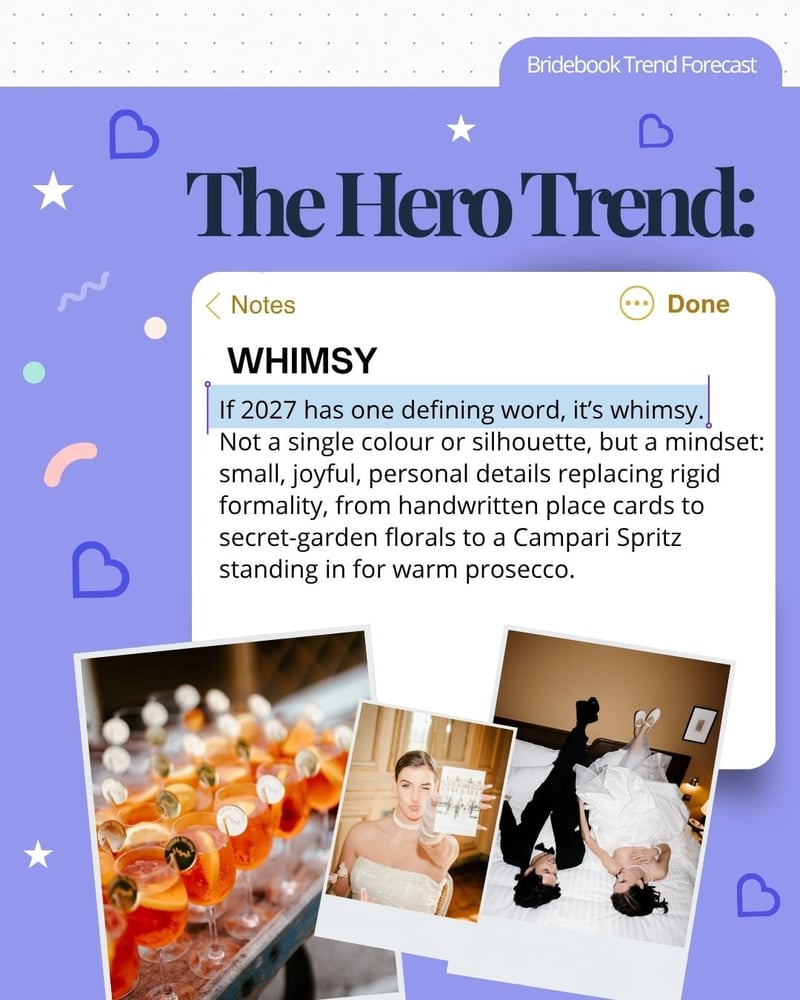
If 2027 has one defining word, it’s whimsy. Not a single colour or silhouette, but a mindset: small, joyful, personal details replacing rigid formality, from handwritten place cards to secret-garden florals to a Campari Spritz standing in for warm prosecco.
Zoe Burke, Head of Brand at Bridebook, says: “Whimsy is fundamentally just joy in its purest form. We’re talking about couples adding a little bit of extra joy to their weddings through tiny details that deliver a big impact on the day. And what’s more, they’re doing it on a faster and tighter timeline than ever.”
That last point matters. Bridebook’s UK Wedding Report shows a fifth of couples now marrying within 12 months of getting engaged – a marked shift from the wider average engagement length of around 26 months. Shorter timelines mean less room for elaborate, multi-vendor set-pieces, and more focus on the small details that make a day feel personal, which is exactly where whimsy thrives.
Pinterest searches for “whimsy weddings” are up 1,000% year on year, and it’s replaced “timeless” as the industry’s word of the moment. Here’s where it’s showing up across every part of the day.
The Wedding Trend Headlines
- Hero trend of 2027: Whimsy – couples are trading polish for personality, from secret-garden florals to handwritten doodles (+1,000% Pinterest search growth)
- Trend of 2027: The private wedding – NDAs, phone-free ceremonies and guest lists built on trust, not obligation
- Colour of 2026 (and still climbing): Butter yellow
- One to watch for 2027: The Italian aesthetic, minus the actual Italy
- TikTok vs. reality: Chartreuse and burgundy dominate WeddingTok; UK couples are searching for neither
- Trend Council pick: The wedding weekend
The Trend Council
Introducing the handpicked panel of wedding industry trend-setters, magic-makers and movers and shakers shaping this forecast:
Planners: Mark Niemierko, celebrity wedding planner; Tessa Williams, A Touch of Nevaeh. Celebrants: Nat Raybould, humanist wedding celebrant, Jennifer Patrice, independent wedding celebrant. Venues: Charlotte Andrews, Bunny Hill. Florists: Amelie Clemson, Lavender Green Flowers. Cakes & Desserts: Nina Rogers, Cakes by Nina. Fashion & Accessories: Debbie Carlisle, bridal accessory designer; Savannah Miller, wedding dress designer; Ella May, Ella May London. Stationery & Styling: Sophie Grant, Scribed by Sophie, Akilah Greyson, Akilah & Co. Hair & Beauty: Eleasha Yarde, OM Makeup Artistry & Beauty.
Trending Wedding Colours
For three years, British weddings were defined by a cool, muted palette – sage green bridesmaid dresses, dusty rose table settings, grey-green foliage and barely-there neutrals. It was elegant, it was safe, and as of 2026, it’s over.
In its place, something warmer, braver and considerably more interesting has arrived – and it’s the last time this particular palette will be “new” before it’s simply the norm going into 2027.
Colour of the Year: Butter Yellow
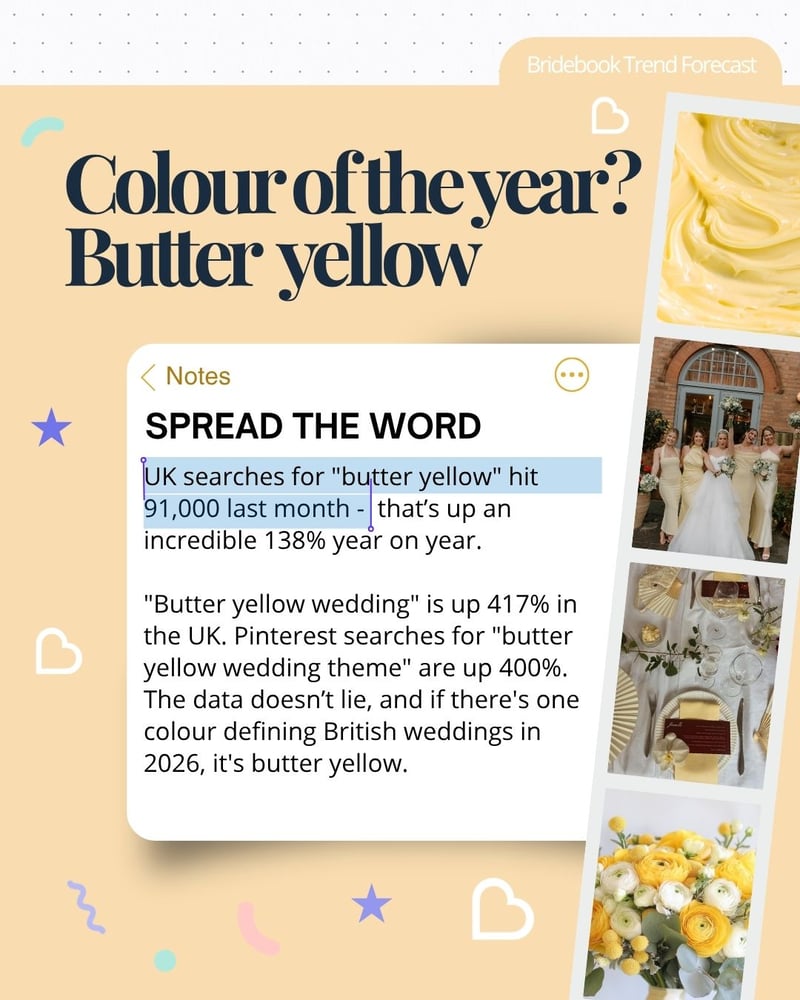
If there’s one colour that defined the British wedding in 2026, it’s butter yellow – and the data makes an extraordinary case for it. UK searches for “butter yellow” hit 91,000 in the last month alone, up 138% year on year.
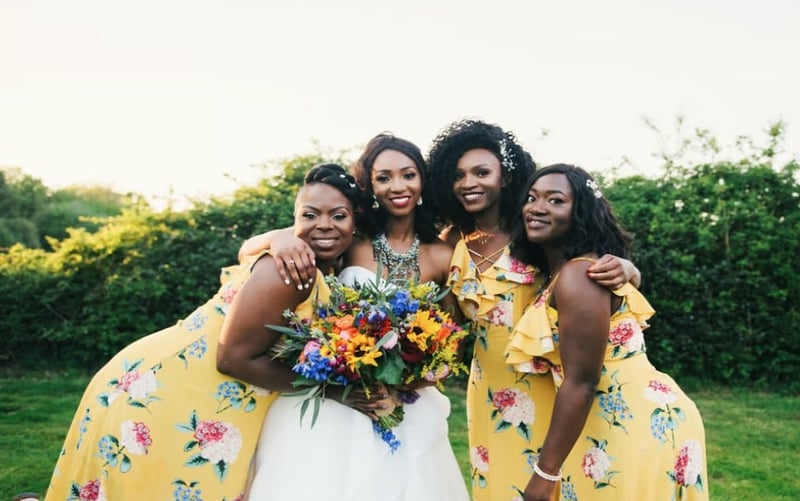
Globally, that figure reaches 865,000 searches in thirty days. “Butter yellow wedding” specifically has seen 3,000 UK searches in the last three months – up 417%. On Pinterest, searches for “butter yellow wedding theme” are up 400% too, confirming the shift well beyond Google alone.
This isn’t the sharp, fashion-week yellow of chartreuse or neon citrus. It’s softer, more romantic, inherently British summer – the colour of afternoon light through a marquee, or wildflowers at the edge of a meadow. Which is, not coincidentally, exactly where British weddings are heading aesthetically right now.
The TikTok Wedding Trend Prediction
If you’ve spent any time on WeddingTok in the last twelve months, you’ll have been told – repeatedly and with great confidence – that chartreuse is the wedding colour of 2026. That sharp, neon yellow-green has dominated mood boards, influenced runway collections and inspired approximately one million Pinterest boards.
UK couples, however, haven’t got the memo. Or rather, they’ve got the memo and politely set it aside. Searches for “chartreuse wedding” in the UK return virtually zero volume. Burgundy, its WeddingTok partner in crime, fares little better.
These are colours being talked about by the wedding industry, for the wedding industry – British couples are reaching for something warmer, more wearable and considerably more flattering in an English summer.
Wedding Colour Trends: What’s Coming Next
Beyond butter yellow, a broader warm palette is assembling itself across British weddings, heading firmly into 2027.
Terracotta has been circling for a while without fully landing yet, but it’s coming. That gap between social media saturation and search behaviour is exactly where the most interesting trends live; by the time a colour shows up in search volume, it’s already mainstream with the people who set the trend in the first place.
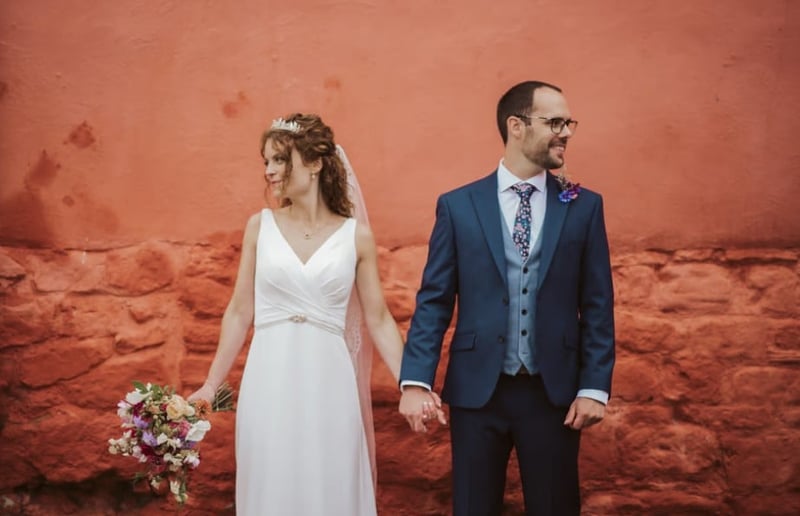
Tomato red is the bolder version of the same story – vivid, Italian, unapologetically warm. Rust, burnt sienna, fig. The entire palette of a late summer evening in Puglia, translated into table linen, candle arrangements and wedding party looks.
Together with butter yellow and lemon, these shades form a cohesive aesthetic for 2027: the Italian terrace palette, reimagined for British celebrations.
The Sage Green Wedding Trend
Sage green is not over. But sage green is no longer a trend, and there’s an important difference.
UK searches peaked at over 4,100 per month in January 2022, when it felt genuinely fresh. It now sits at around 700-860 per month – still significant, but no longer climbing.
Sage green has had a rebrand: it’s now Millennial Mint, appreciated as a nostalgic throwback rather than a fresh idea.
The Celebration: The Private Wedding Trend
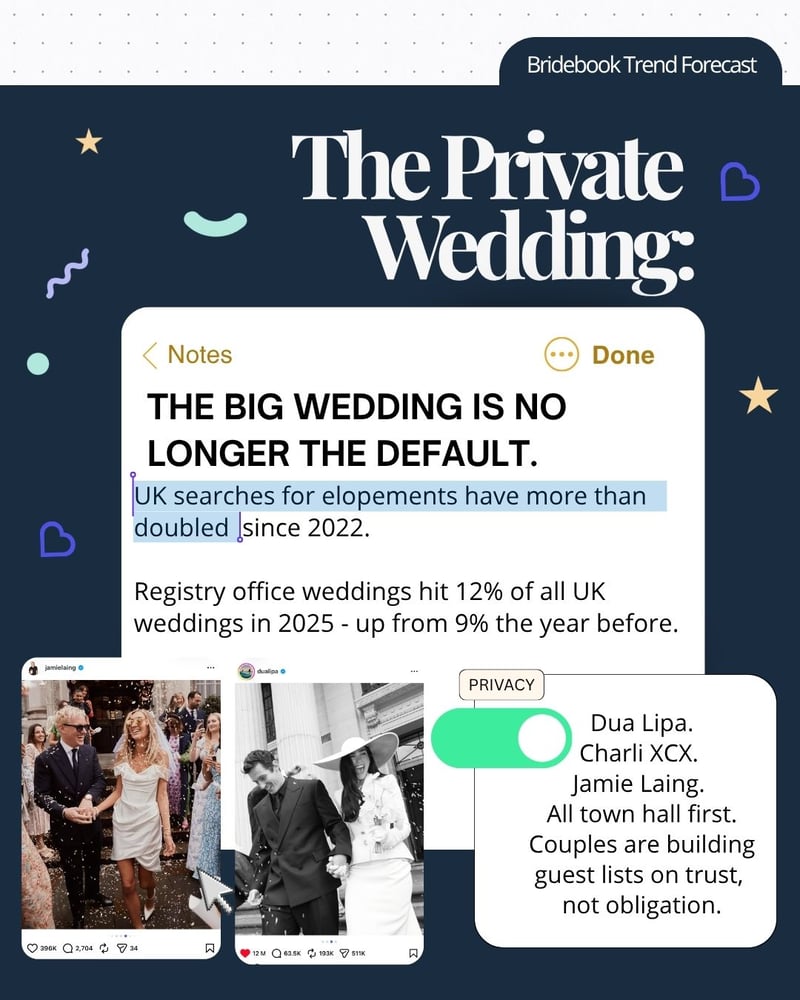
Whimsy isn’t only about pretty details – it’s also showing up as a guarded, protective instinct around who gets let in. The big wedding is no longer the default. That’s not a niche observation or a post-pandemic blip; it’s a sustained, data-backed shift in how British couples are approaching one of the biggest days of their lives.
UK searches for elopements have more than doubled since 2022 and held that level consistently into 2026. Micro wedding searches have grown steadily year on year. And registry office searches – perhaps the most telling figure of all – sit at nearly 5,700 per month, completely stable, completely mainstream.
Registry office weddings accounted for 12% of all UK weddings in 2025, up from 9% in 2024, and that number should climb further given a run of high-profile town hall weddings in recent years: Dua Lipa and Callum Turner married at Old Marylebone Town Hall in May 2026, Dua Lipa in a white skirt-and-blazer set with a wide-brimmed hat (more on that to come), ahead of a larger celebration in Italy; Charli XCX and George Daniel married at Hackney Town Hall in 2025; and Jamie Laing and Sophie Habboo set the tone for it all back in 2023.
What’s driving it isn’t budget restrictions or lack of ambition – the average UK wedding still costs £20,604, and a registry office ceremony is a format choice, not a cost-cutting one. It’s couples deciding that the guest list, the venue and the format should serve them, not the other way around.
Trend Council Picks: Wedding Planners
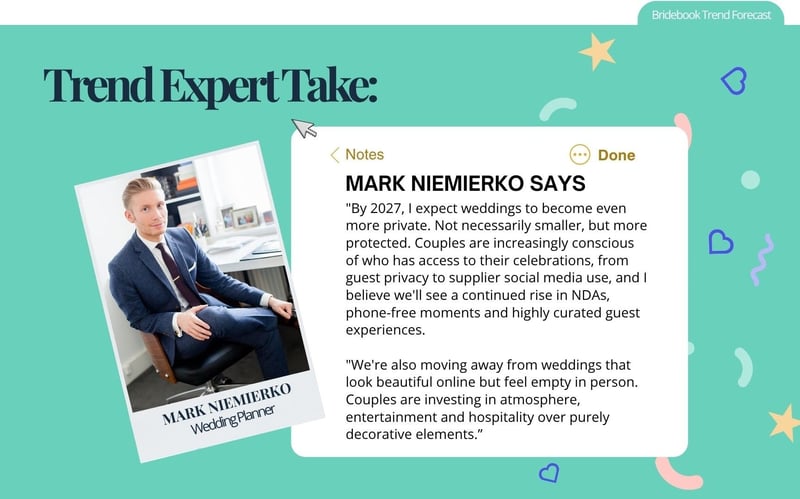
Celebrity wedding planner Mark Niemierko says:
“By 2027, I expect weddings to become even more private. Not necessarily smaller, but more protected. Couples are increasingly conscious of who has access to their celebrations, from guest privacy to supplier social media use, and I believe we’ll see a continued rise in NDAs, phone-free moments and highly curated guest experiences.
“We’re also moving away from weddings that look beautiful online but feel empty in person. Couples are investing in atmosphere, entertainment and hospitality over purely decorative elements. Guests want to be surprised, engaged and looked after, and the most memorable weddings will feel more like immersive house parties than traditional receptions.
“I predict wedding weekends will continue to grow, with celebrations stretching across several days and multiple locations. Rather than a single event, couples are creating a series of experiences, from intimate welcome dinners and cultural celebrations to late night after parties and recovery brunches.
“Nostalgia is becoming one of the biggest influences on modern weddings. As life becomes more digital, couples are embracing things that feel real and tangible. We’re seeing the return of film photography, disposable cameras and Polaroids, alongside a renewed appreciation for music that guests genuinely know and love. The biggest dance floor moments are often still the songs from the 80s, 90s and early 2000s. Couples are looking for emotion over perfection, and nostalgia delivers exactly that.”
Tessa Williams, wedding planner and owner of A Touch of Nevaeh says:
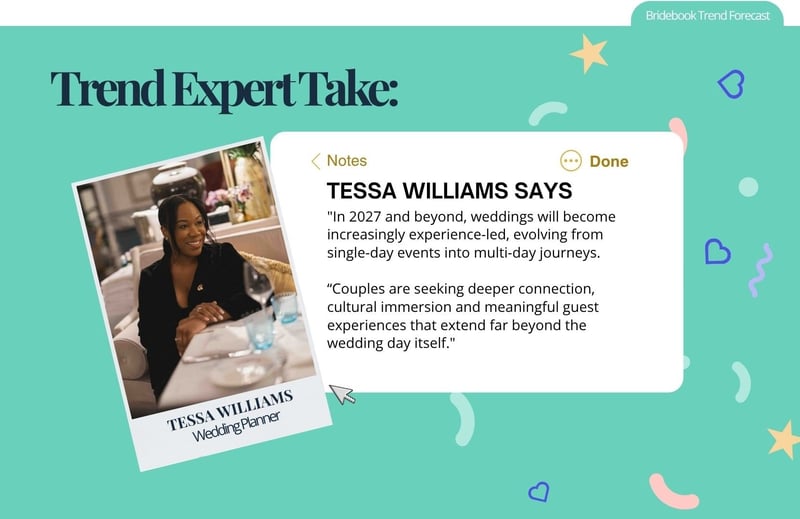
“In 2027 and beyond, weddings will become increasingly experience-led, evolving from single-day events into multi-day journeys. Couples are seeking deeper connection, cultural immersion and meaningful guest experiences that extend far beyond the wedding day itself.”
Trend Council Picks: Wedding Planners
Humanist wedding celebrant Nat Raybould says:
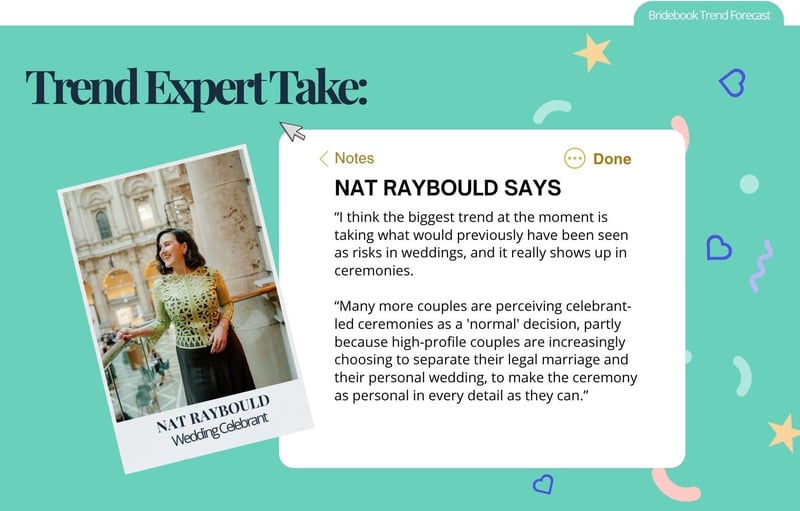
“I think the biggest trend at the moment is taking what would previously have been seen as risks in weddings, and it really shows up in ceremonies. Many more couples are perceiving celebrant-led ceremonies as a ‘normal’ decision, partly because high-profile couples are increasingly choosing to separate their legal marriage and their personal wedding, to make the ceremony as personal in every detail as they can.
“I’m also seeing couples ‘break the rules’ of Western weddings within their ceremonies – taking the rings off the best man and giving them to the mothers, or to the oldest and youngest in the room, to add extra layers of meaning. More couples than ever are choosing group readings written by the group themselves, rather than something Googled and picked from a list.
“Lastly, I’m seeing a general trend towards more intimate guest lists. Couples are thinking about who they truly love and cherish as part of their circle, rather than tick-boxing every second cousin once removed. I think it’s an exciting newer normal heading into 2027 and beyond to see multi-day weddings with 30-45 guests rather than a single-day event for 120.”
It’s a pattern that explains why so many high-profile couples now marry quietly at a register office before a separate, larger celebration.
Independent wedding celebrant Jennifer Patrice says:
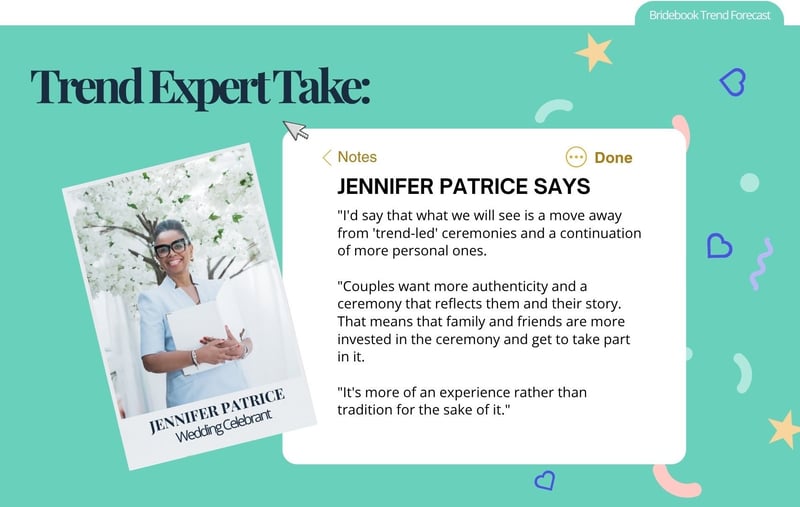
“I’d say that what we will see is a move away from ‘trend-led’ ceremonies and a continuation of more personal ones.
“Couples want more authenticity and a ceremony that reflects them and their story. That means that family and friends are more invested in the ceremony and get to take part in it.
“It’s more of an experience rather than tradition for the sake of it.”
The Dry Hire Wedding Trend
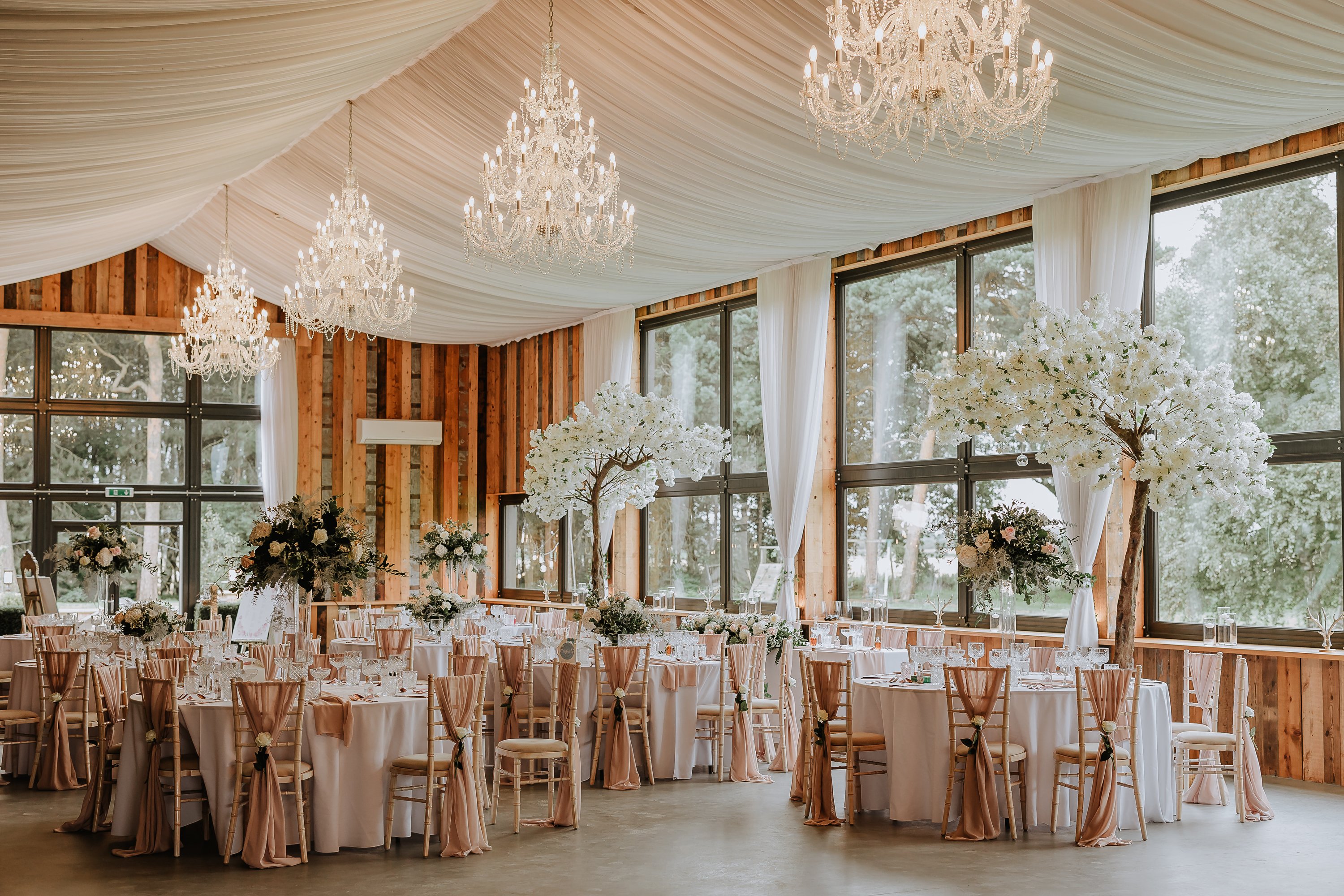
Alongside the shift toward intimacy, something else is growing fast: couples who want control – not just over the guest list, but over every detail of the day, from caterer and drinks to suppliers and schedule.
Dry hire venue searches hit 2,000 in June 2026, up 188% year on year. Couples are looking for venues that hand them the keys and leave them in control, and that appetite is accelerating fast.
Trend Council Pick: Wedding Venues
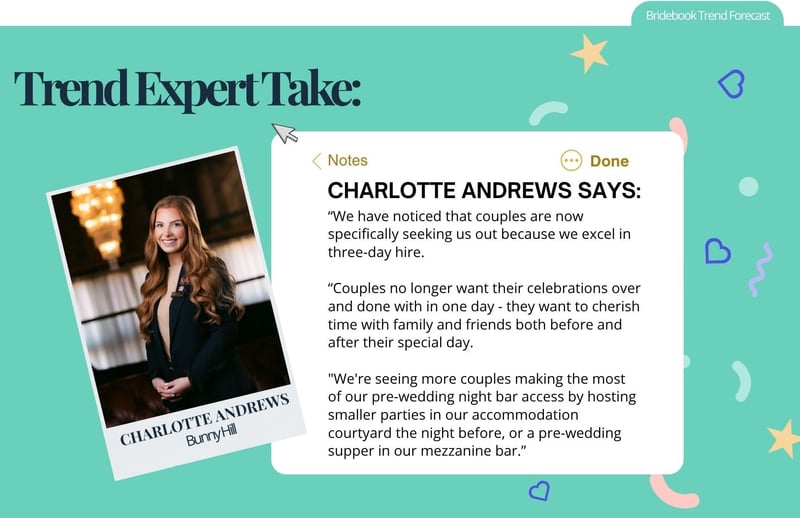
Charlotte Andrews, Head of Weddings at Bunny Hill, says:
“As an exclusive-hire venue specialising in three-day hire since 2018, we haven’t necessarily seen an increase in this type of booking for 2027, as that’s what we already offer. However, we have noticed that couples are now specifically seeking us out because we excel in this type of wedding. Couples no longer want their celebrations over and done with in one day – they want to cherish time with family and friends both before and after their special day.
“We’re seeing more couples making the most of our pre-wedding night bar access by hosting smaller parties in our accommodation courtyard the night before, or a pre-wedding supper in our mezzanine bar. Late check-out the day after means there’s plenty of time for an early afternoon BBQ, and we’ve even seen more couples extending their stay an extra night.
“We have seen a spike in couples looking to step away from a more traditional wedding day, often hosting an intimate daytime ceremony with their larger guest numbers joining them in the evening for the relaxed celebrations. Many couples are also exploring dry hire options to gain complete creative control over their day, often focusing primarily on the caterers they can use.”
Italian Inspiration
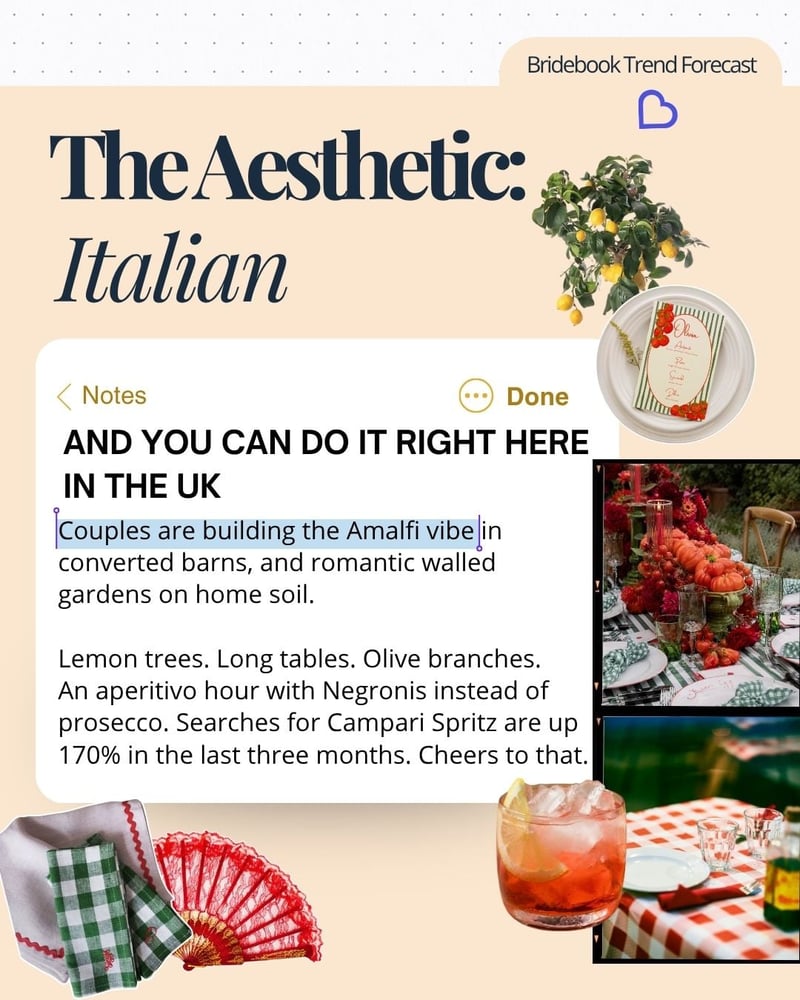
Not every couple can get married on an Amalfi terrace. That hasn’t stopped them trying.
The Italian aesthetic – lemon trees, long tables, golden hour aperitivo, the unhurried feeling of a meal that isn’t going anywhere – has filtered firmly into British wedding planning. Vineyard wedding searches, while still significant, are softening, because couples no longer need an actual vineyard to create that feeling.
The mood-board version of this trend – terracotta pots, olive branches, linen napkins, a grazing table that doubles as a centrepiece – is being recreated in barn conversions, walled gardens and country houses across Britain.
This is less a venue trend than an atmosphere one. Couples aren’t just choosing outdoor spaces; they’re building an experience for their guests, and by 2027 this is likely to be the default British wedding aesthetic rather than a niche one.
Wedding Flower Trends
The Secret Garden
No colour palette or town hall wedding tells the full whimsy story without flowers. Nicknamed “meadowcore” by the industry, this trend centres on free-flowing, wildflower-inspired arrangements that look as though they grew exactly where they belong – celebrating imperfection over the stiff, structured florals of recent years.
Flowers are also breaking out of the bouquet and centrepiece. Think floral tunnels, in-the-round ceremony layouts and a theatre-in-the-garden feel, alongside prairie planting, pollinator-friendly borders and meadow-style aisles.
UK searches for “wildflower wedding” are up 66% in the last twelve months, now sitting above 28,000 per month, while Pinterest searches for “flower installations” have grown by almost 200% in the same period.
Trend Council Pick: Wedding Florists
Amelie Clemson, Head of Weddings at Lavender Green Flowers, says:
“Overall, we’re seeing a shift away from the modern simplicity that has defined 2026. It has very much been the year of calla lilies and amaranthus, but couples are increasingly looking for something that feels different from the imagery that has dominated Instagram feeds and Pinterest boards. While the classic English garden aesthetic remains timeless and transcends seasonal trends, I predict that 2027 will usher in lighter, airier floral designs with a whimsical, romantic feel – think soft, effortless arrangements that evoke the world of Jane Austen.
“Alongside this, the continued emphasis on sustainability is shaping couples’ floral choices. Just as many are prioritising locally sourced food and wine, English-grown flowers continue to grow in popularity. This doesn’t necessarily mean a wildflower look; instead, delicate blooms and wispy stems are being used to create movement, texture and an overall sense of softness that feels set to define 2027.
“At the other end of the spectrum, large-scale floral installations remain a defining feature of luxury celebrations. Dramatic designs continue to dominate larger weddings, inspired by high-profile celebrations, including Sofia Richie’s wedding, and the growing influence of destination wedding planners, with immersive floral experiences showing no signs of slowing down.
“Looking ahead, celebrity weddings will inevitably continue to influence the industry, and I expect we’ll see a renewed shift in couples’ visions once we see content from Taylor Swift’s wedding, much as we’ve seen previous celebrity weddings shape colour palettes, floral choices and overall styling trends.”
Wedding Food & Drink Trends
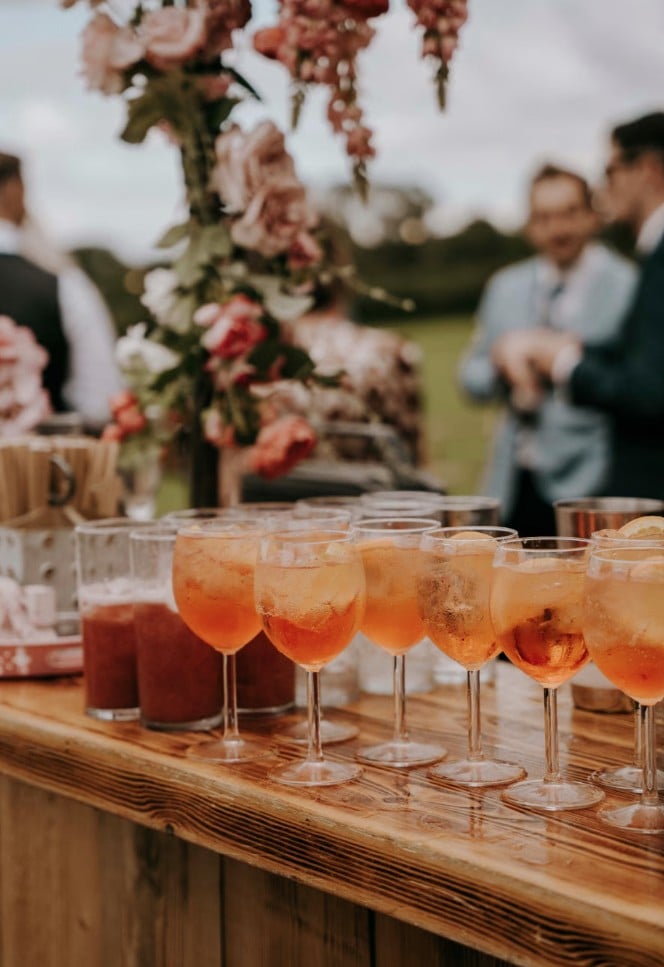
Formal three-course wedding breakfasts are out. In their place: a more relaxed, generous, intimate feeling. British couples in 2026 and heading into 2027 are feeding their guests the way they’d feed their closest friends – abundantly, informally, and with a strong Italian accent.
The Naked Cake Is No More
The naked wedding cake had a good run – perhaps longer than any of us expected. UK searches have dropped from a peak of over 5,100 per month in January 2022 to around 2,700 now, and what’s telling is that it hasn’t recovered. It has flatlined.
What’s replacing it is more interesting than what came before: the retro celebration cake – bold icing, hand-painted details, maximalist tiers that look like they belong at a 1970s Italian wedding.
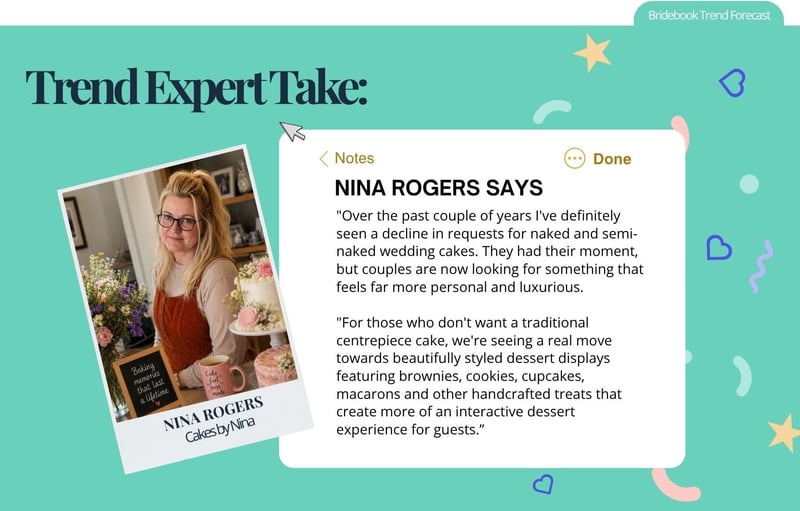
“Over the past couple of years I’ve definitely seen a decline in requests for naked and semi-naked wedding cakes. They had their moment, but couples are now looking for something that feels far more personal and luxurious,” says Nina Rogers of Cakes by Nina.
“For those who don’t want a traditional centrepiece cake, we’re seeing a real move towards beautifully styled dessert displays featuring brownies, cookies, cupcakes, macarons and other handcrafted treats that create more of an interactive dessert experience for guests.
“I’m seeing far more requests for handcrafted sugar flowers rather than fresh flowers, with couples specifically asking for sugar artistry that becomes part of the overall design. There’s a renewed appreciation for traditional craftsmanship and the artistry involved in creating something entirely by hand.”
Personalisation is running through every commission Nina takes on – pets, hobbies, favourite places, details that make a cake impossible to copy – and heading into 2027, her order book is proof of it: no two cakes alike, driven by couples chasing individuality over whatever’s fashionable.
It isn’t just a style shift, either. Nina points to a widening gap between what couples expect and what they’re prepared to pay for it: “One challenge I have noticed is that while expectations for luxury, highly detailed cakes continue to rise, budgets haven’t necessarily kept pace.
“In many cases they’re closer to what couples were spending five years ago, despite significant increases in ingredient costs, materials and the many hours of skilled craftsmanship that bespoke wedding cakes require.”
The Tower Trend
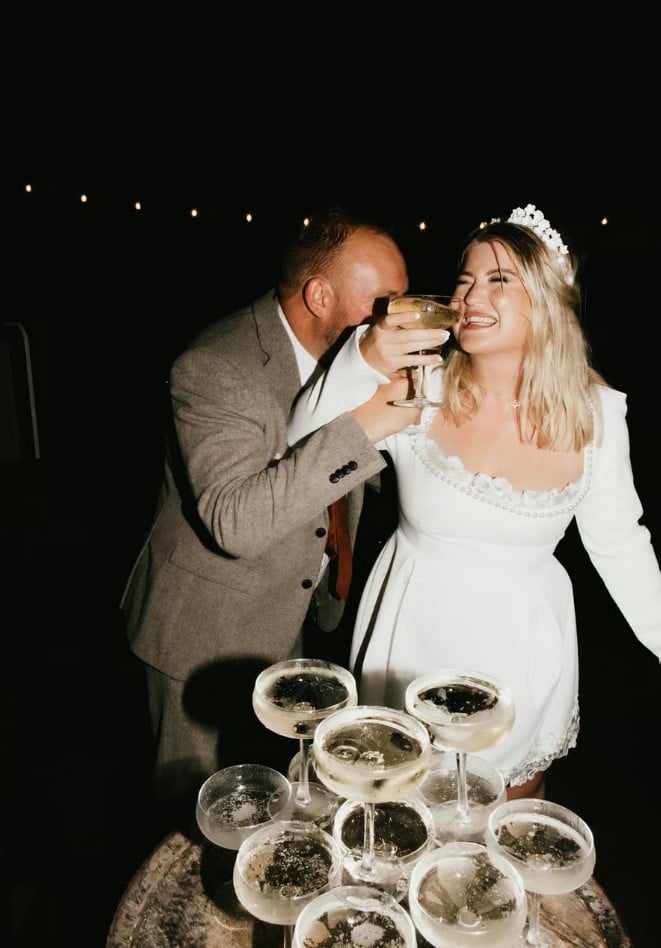
The Champagne tower has always been theatre. What’s changed is that couples have realised almost anything can be theatre, if you stack it high enough.
Croquembouche – that French tower of cream-filled choux pastry bound in spun caramel – is the most searchable of the alternatives at around 100 searches per month in a wedding context, and climbing. Tiramisu is doing similar numbers under a different name: Pinterest searches for “tiramisu tower” and “tiramisu wedding cake” are up 700% and 400% respectively year on year, whether piled into towering cakes or served as individual ice-cream-scooped coupes.
Macaron towers. Profiterole pyramids. Gelato carts wheeled out at golden hour. The patisserie-as-centrepiece trend fits neatly inside the Italian terrace aesthetic, and it hands couples a visual that’s virtually guaranteed to get guests reaching for their phones.
Aperitivo Hour
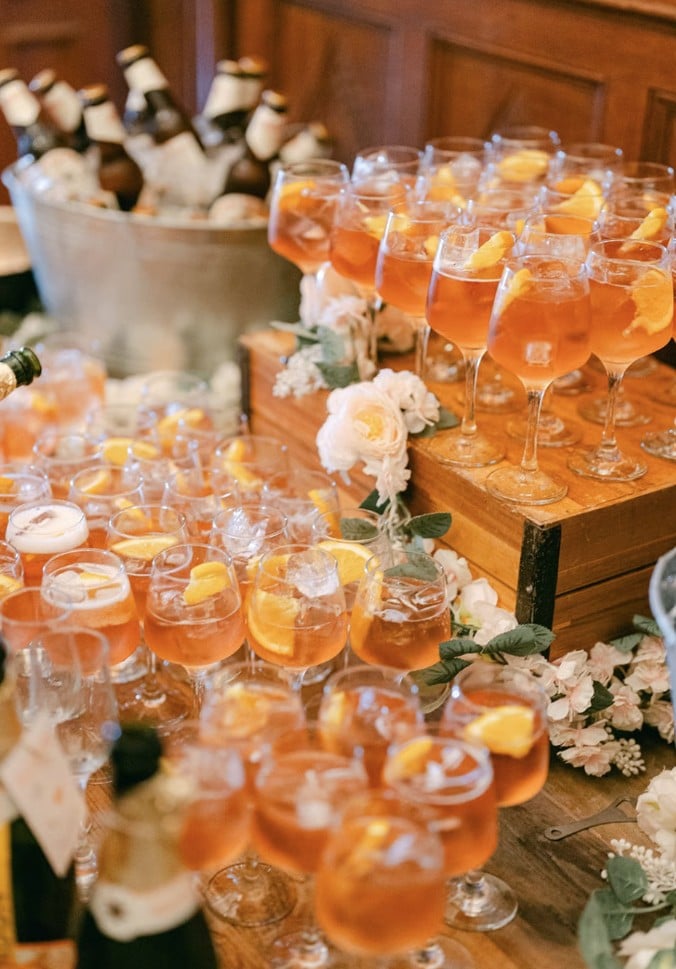
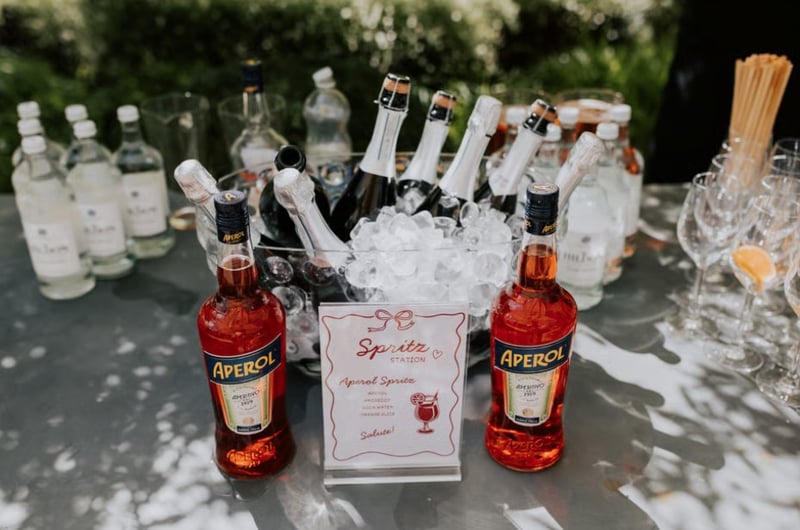
If there’s one borrowed Italian ritual reshaping the flow of British weddings, it’s the aperitivo hour – not a drinks reception with warm prosecco and a few canapés, but something more considered. Negronis. Spritzes. Bowls of olives and good bread. A moment that signals to guests: this is going to be that kind of day.
Google searches for “Campari Spritz” have climbed 170% in the last three months alone. The non-alcoholic offering is evolving alongside it, too – mocktail bar hire terms appeared as brand-new searches in May 2025 and are already tracking upward. The sober-curious wedding isn’t a niche consideration anymore; it’s a reality guests have come to expect.
Late Night Wedding Entertainment
Searches around “wedding entertainment ideas” hit 1,300 per month, and a significant portion of that conversation is about what happens after the first dance.
The late-night food moment has gone from nice-to-have to expected, and bacon baps and chips don’t cut it anymore – think gourmet truffle toasties, taco trucks, espresso martini bars and more. The most exciting part of the day is fast becoming the evening party.
Wedding Fashion Trends
Bridal fashion in 2026 is defined less by a single silhouette than by a single question: why choose?
The Two-in-One Wedding Dress
The convertible wedding dress – ceremony gown with a detachable skirt, revealing a shorter or sleeker look beneath – has moved from niche to notable. Searches for convertible and detachable-skirt styles have grown consistently since 2023, driven by couples who want two distinct looks without two separate dresses, two separate fittings and two separate price tags.
Wedding Trend Council Picks: Wedding Dress Designers
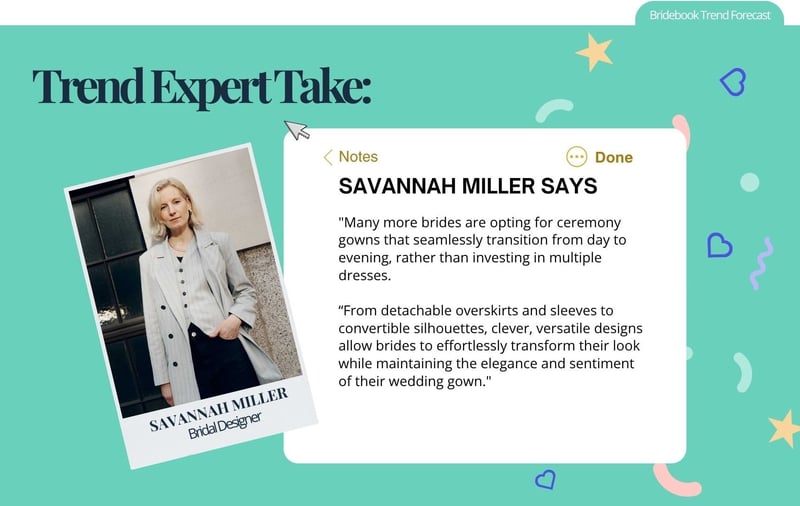
Wedding dress designer Savannah Miller is seeing exactly that shift on the fitting room floor: “Many more brides are opting for ceremony gowns that seamlessly transition from day to evening, rather than investing in multiple dresses. From detachable overskirts and sleeves to convertible silhouettes, clever, versatile designs allow brides to effortlessly transform their look while maintaining the elegance and sentiment of their wedding gown.”
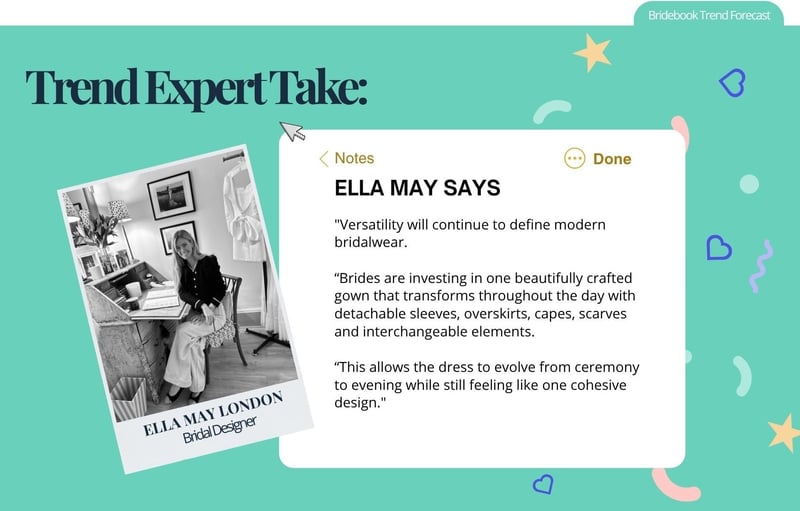
Ella May of Ella May London agrees, framing it as part of a bigger shift towards gowns built to do more than one job: “Versatility will continue to define modern bridal. Brides are investing in one beautifully crafted gown that transforms throughout the day with detachable sleeves, overskirts, capes, scarves and interchangeable elements, allowing the dress to evolve from ceremony to evening while still feeling like one cohesive design.”
Heading into 2027, expect this to extend further into full “wedding weekend wardrobes” – a distinct look for the ceremony, the reception and the morning after.
The New Volume: 2027’s Sculptural Silhouette
Beyond versatility, 2027 bridal is getting bolder in shape. Savannah Miller says: “Sculptural silhouettes will continue to trend for 2027. Embracing architectural construction – exaggerated skirts, sculpted drop-waists, and precisely engineered draping that creates impact through form alone.
The new volume feels intentional and refined, balancing bold proportions with clean lines. Whether it’s a softly draped sleeve, a voluminous skirt or a structured drop waist that flares into dramatic fullness, these timeless silhouettes celebrate craftsmanship and precision.”
Stop Trying to Make Lace Happen
Every few seasons, the wedding industry announces the return of lace. Every few seasons, the data tells a different story. UK searches for lace wedding dresses have declined steadily from over 4,700 per month in early 2022 to around 2,200-2,900 now.
Lace remains beautiful, remains wearable and remains on the rails of every bridal boutique in Britain – but it isn’t having a moment. It’s a timeless choice instead.
The Bridal Suit
The bridal suit has evolved from a statement to a staple, driven in part by the rise of the registry office wedding – and it just got its highest-profile validation yet.
When Dua Lipa married Callum Turner at Old Marylebone Town Hall in May, she wore a white skirt-and-blazer set with a wide-brimmed hat: exactly the silhouette this section is describing, worn at exactly the kind of ceremony this piece argues is going mainstream.
Peak searches for bridal suits hit around 1,150 per month in early 2023 and have settled at a steady 430-530. It’s no longer a statement or a subversion – it sits alongside the dress as an option, rather than challenging it.
Wedding Trend Council Picks: Wedding Accessories
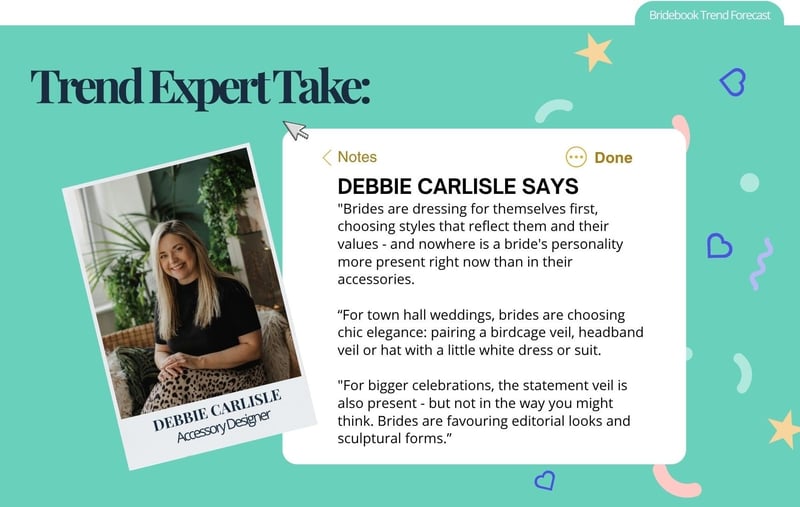
Accessory designer Debbie Carlisle says:
“Brides are dressing for themselves first, choosing styles that reflect them and their values – and nowhere is a bride’s personality more present right now than in their accessories. For town hall weddings, brides are choosing chic elegance: pairing a birdcage veil, headband veil or hat with a little white dress or suit, with extra points if it’s an outfit they can wear again.
“For bigger celebrations, the statement veil is also present – but not in the way you might think. Brides are favouring editorial looks and sculptural forms: short drop veils with lashings of movement, crystal- or pearl-embellished birdcage veils, tulle or lace micro veils. Seen all over the catwalk at New York Bridal Fashion Week and London Bridal Week, the micro veil is definitely having its moment among style-led brides.
“Pearls are definitely a bride’s best friend – from sculptural freshwater pearls to perfectly-formed round vegan crystal pearls – and the long drop pearl earring is a firm favourite, adding effortless movement and modern elegance.”
One veil silhouette in particular is leading its own quiet revival, according to Savannah Miller: “The Juliet cap veil [is] emerging as one of the season’s most captivating revivals. Once synonymous with vintage elegance, the silhouette has been reimagined for the modern bride – soft, fashion-forward and effortlessly cool. Framing the face with quiet delicacy, it brings an ethereal quality that feels both nostalgic and refreshingly contemporary.”
Across every silhouette, the same idea keeps surfacing. As Ella May puts it: “I do not think brides are looking for more trends; I think they are looking for more meaning. The most beautiful dresses are those that feel deeply personal, are impeccably made and evolve with the bride throughout the wedding day. That is where I believe bridal is heading.”
Wedding Stationery & Styling Trends
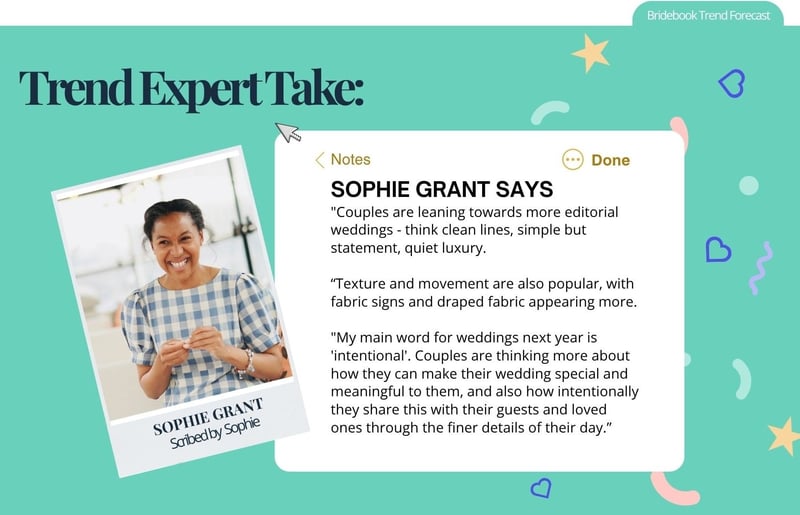
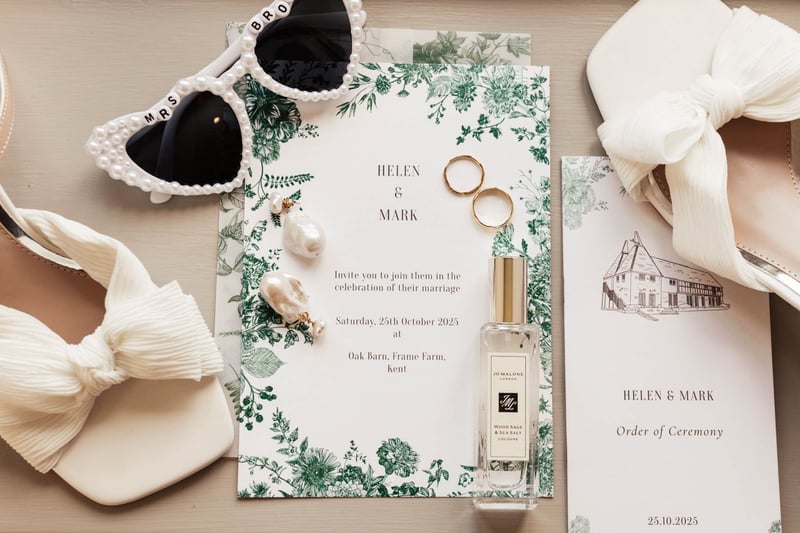
Editorial is the word of 2027, as much as intentional is. Clean lines, statement simplicity and quiet luxury are replacing anything fussy, with texture and movement showing up through fabric signage and draped fabric details rather than print alone.
That editorial backdrop hasn’t stopped whimsy creeping in exactly where it counts: in the details only guests get close enough to see. Handwritten touches are having a moment – loose line-drawings on menus, chalk sketches on bar signage, and handwritten thank-you notes tucked into individually chosen favours. Stationery shapes are getting playful too, with scalloped edges, die-cut shapes and bow motifs turning up on save-the-dates and place cards. Pinterest searches for “whimsy doodles” are up 1,500% year on year, with more than 20,000 people searching “wedding doodles” for inspiration in the last month alone.
Sophie Grant of Scribed by Sophie says:
“Couples are leaning towards more editorial weddings – think clean lines, simple but statement, quiet luxury. Texture and movement are also popular, with fabric signs and draped fabric appearing more.
“My main word for weddings next year is ‘intentional’. Couples are thinking more about how they can make their wedding special and meaningful to them, and also how intentionally they share this with their guests and loved ones through the finer details of their day. The finer details will continue to matter most to couples, whether it’s themed according to interests or table names that represent places, books or other things that are meaningful to the couple.”
Akilah Greyson, of Akilah & Co, says:
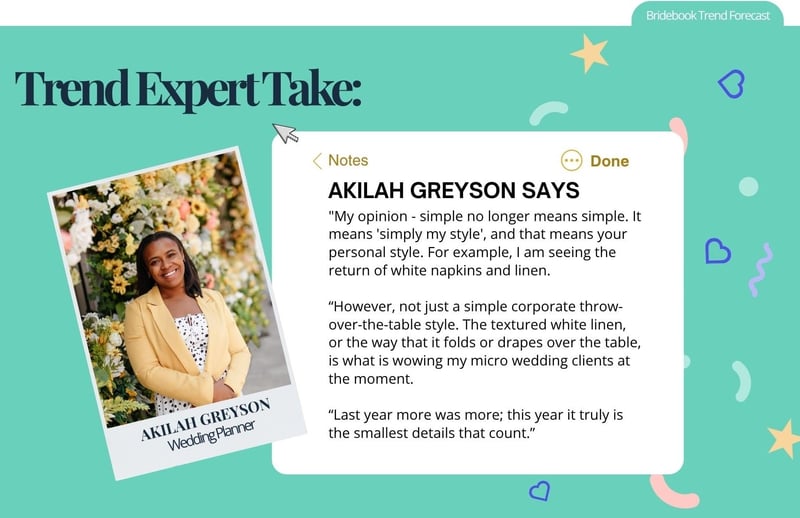
“My opinion – simple no longer means simple. It means ‘simply my style’, and that means your personal style. For example, I am seeing the return of white napkins and linen. However, not just a simple corporate throw-over-the-table style. The textured white linen, or the way that it folds or drapes over the table, is what is wowing my micro wedding clients at the moment. Last year more was more; this year it truly is the smallest details that count.
“The only thing I would predict from high-profile weddings is the intimate, secretive feeling, and how it can be achieved on a day that is considered to be the best, most important day of their lives.”
Wedding Scent Trends
The most overlooked element of wedding planning isn’t the flowers, the cake or the stationery. It’s what the day smells like.
Wedding scenting is becoming one of the most considered details in high-end wedding planning, and it’s filtering fast into the mainstream: a signature fragrance worn by the couple, a scented candle at every table, a room fragrance chosen specifically for the ceremony space – the idea that a wedding should engage all five senses, not just the ones a photographer can capture.
Scent is also the detail most likely to trigger memory, which makes it arguably the most powerful low-cost investment a couple can make in how their wedding is remembered.
Wedding Beauty Trends
If 2026 was about restraint – minimalist, structured bridal looks – 2027 is a swing back toward romance. Think a pensive Jane Austen heroine or golden-age Hollywood glamour with a touch of Brontë-esque melancholy: lightly flushed, sculpted cheeks paired with windswept, undone hair, rather than anything set in place for twelve hours.
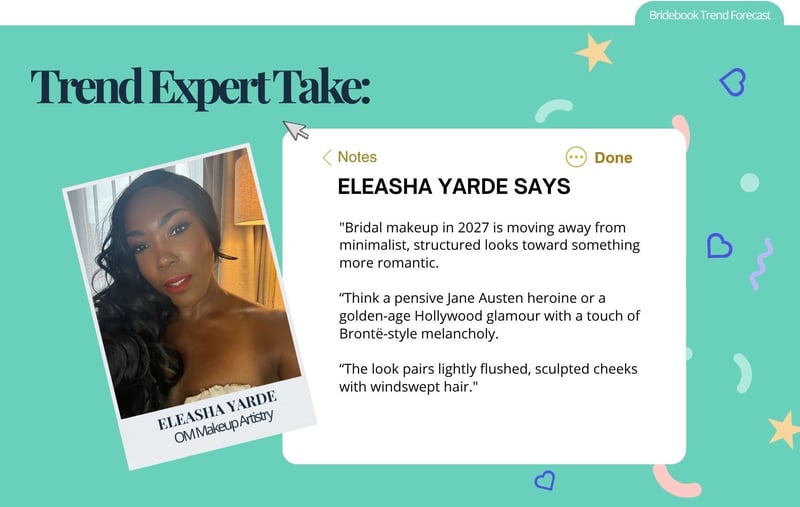
Eleasha Yarde says:
“Bridal makeup in 2027 is moving away from minimalist, structured looks toward something more romantic – think a pensive Jane Austen heroine or a golden-age Hollywood glamour with a touch of Brontë-style melancholy. The look pairs lightly flushed, sculpted cheeks with windswept hair.”
Wedding Trend FAQs
What does “wedding whimsy” mean?
Wedding whimsy is less a single look than a mindset: small, personal, joyful details – a handwritten note, a wildflower posy, a playful dessert display – in place of a rigid, formal script. Searches for “whimsy weddings” are up 1,000% on Pinterest year on year, making it the defining trend of 2027.
What are the wedding trends for 2027?
Bridebook’s Wedding Trend Council forecasts a shift toward whimsical, private, multi-day celebrations, a warm “Italian terrace” colour palette of butter yellow, terracotta and tomato red, and continued growth in registry office and dry hire weddings, as couples prioritise atmosphere and guest experience over traditional formality.
What is the wedding colour of 2027?
Butter yellow led 2026 and is still climbing, with terracotta and tomato red emerging as the next wave for 2027. Chartreuse and burgundy dominate wedding social media but show minimal UK search demand, suggesting a gap between what’s viral and what couples are actually choosing.
Are small weddings still trending in 2027?
Yes. UK searches for elopements have more than doubled since 2022, and registry office weddings rose from 9% of UK weddings in 2024 to 12% in 2025. High-profile town hall weddings, including Dua Lipa and Callum Turner’s, have reinforced the trend.
What’s replacing the naked wedding cake?
Retro, maximalist celebration cakes with bold icing and hand-painted detail, alongside a wider trend for dramatic dessert “moments” like croquembouche towers, tiramisu towers and gelato carts.
Bridebook is the world’s #1 wedding planning platform, used by over 2.8 million couples. Our content is informed by real data from the Bridebook UK Wedding Report, which draws on responses from thousands of couples planning their weddings each year. Where expert input is included, contributors are named and their credentials verified. We update our articles regularly to ensure prices, statistics, and advice reflect current market conditions.
Last reviewed: July 2026
Ready to plan a wedding that feels entirely yours? Explore more wedding inspiration on Bridebook and start building your vision today.