The Wedding Spend: A Barn Wedding in Lancashire Under £10,000

Jess and Tom got married on a January Saturday in Lancashire. They spent less than half the national average cost of a wedding. Here’s exactly where every pound went – and what they’d do differently.
- The couple: Jess & Tom*
- The region: North West
- The wedding date: Saturday 14th March, 2026
- The guest numbers: 30 total
- Total spend: £9,200
When Jess and Tom started planning their wedding, the number they kept coming back to wasn’t a venue capacity or a colour palette. It was 4pm.
A twilight wedding ceremony, candles already lit when guests arrived, dinner sliding into dancing without a long afternoon in between. That feeling – intimate, warm, a little dramatic – became the brief everything else was built around.
They chose a working farm wedding venue on the edge of the Forest of Bowland with a converted stone barn that holds up to 80. In January, on a Saturday, it cost them £1,800 for exclusive use from 3pm to midnight. In August, the same venue would have been closer to £3,500. The date wasn’t a compromise, it was a savvy decision.
“We actually love spring,” says Jess, a primary school teacher from Preston. “We wanted it cosy and candlelit. July would have felt completely wrong for us.” Tom, who works in logistics, had one non-negotiable: a live band. Everything else, they were flexible on.
With 30 guests seated for dinner, catering was their biggest spend at £2,700 – a set three-course menu from the venue’s preferred supplier, with a grazing board and drinks reception on arrival. Evening food was a deliberate skip. By 9pm, guests were dancing rather than queuing for a burger van, and nobody noticed the absence.
“We didn’t have evening food and genuinely nobody mentioned it. We had good wine, a great band and people were on the dancefloor by half eight.”
Photography was the one area they stretched the budget. At £1,400, their wedding photographer was the single most expensive supplier outside of catering, and the one Jess says she’d spend even more on if she did it again. “The photos are everything. The day goes so fast. I’d probably have added a videographer too – that’s my one regret.”
They skipped a wedding planner entirely, managing suppliers themselves over about eight months of planning. They also chose a local wedding celebrant over a registrar – at £480, it was a decision driven partly by availability on their chosen date, but one that paid off unexpectedly.
“Our celebrant spent two hours with us before our wedding just talking about how we met, what we loved about each other. The ceremony felt completely ours. I can’t imagine a registrar doing that.”
Flowers were kept simple – dried arrangements sourced from an Etsy seller in Yorkshire, supplemented by foliage from Tom’s parents’ garden. Total spend: £280. Stationery was designed on Canva and printed locally for £60. The cake – a single-tier naked cake from a local baker – came in at £220.
The dress was Jess’s most personal spend. At £980 from a bridal boutique in Manchester, it was slightly more than she’d originally planned, but she tried it on first and that was that. Tom wore a suit he already owned, tailored for £150.
“I spent less than £10,000 and I have never once thought I wish we’d spent more. I think about what we’d have spent that extra £10,000 on and I genuinely can’t answer it.”
Their total came in at £9,200 – well under the North West average of £17,342, and less than half the UK national average of £20,604. The difference went into a house deposit, which felt like the right trade-off for them. It won’t be for everyone.
But Jess and Tom’s day is proof that the number on the invoice and the quality of the memory don’t have to move together.
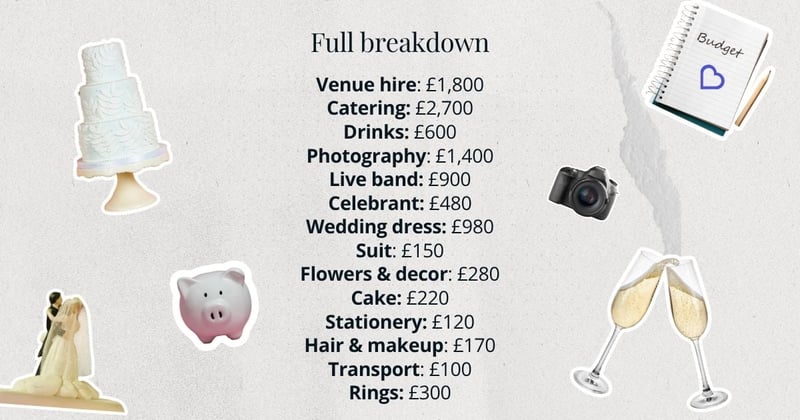
The Spend Table
| Category | Spend |
|---|---|
| Venue hire (exclusive use, 3pm–midnight) | £1,800 |
| Catering — reception dinner (30 guests) | £2,700 |
| Drinks — reception and dinner | £600 |
| Photography | £1,400 |
| Live band | £900 |
| Celebrant | £480 |
| Wedding dress | £980 |
| Menswear (tailoring) | £150 |
| Flowers and décor | £280 |
| Cake | £220 |
| Stationery | £120 |
| Hair and makeup | £170 |
| Transport | £100 |
| Rings | £300 |
| Total | £9,200 |
*Names have been changed. Figures reflect actual spend. The UK national average wedding cost is £20,604 (Bridebook, 2026). The North West England average is £17,342.
Related articles